A new model for reading where your marketing function actually sits, measured against the revenue system rather than against itself.
Every B2B marketing maturity model published in the last decade measures the same thing. How sophisticated the marketing function has become at its own job.
Forrester. Highspot. Iron Horse. Mower. Integrate. The stage labels vary across them. The object being measured does not. Better tools. Cleaner data. More attribution. More integration. The implied endpoint is a fully developed marketing function: predictive, AI-enhanced, at the C-suite table, influencing product and pricing.
Here is what those models cannot explain.
Why companies hit every "Stage 4" indicator and still miss the revenue number. Why CMOs running mature functions get replaced on 18-month cycles. Why the same pattern repeats across portfolio companies with different leaders and different stacks. Why PE operators keep calling the problem a "marketing problem" when the marketer keeps changing and the outcome does not.
The models cannot explain it because the models are looking at the wrong object.
A fully developed marketing function and a fully integrated revenue system are different things. A function can score high on the first while contributing almost nothing to the second. That gap is where every "marketing isn't producing" conversation actually lives.
The maturity was never the issue. The architecture was.
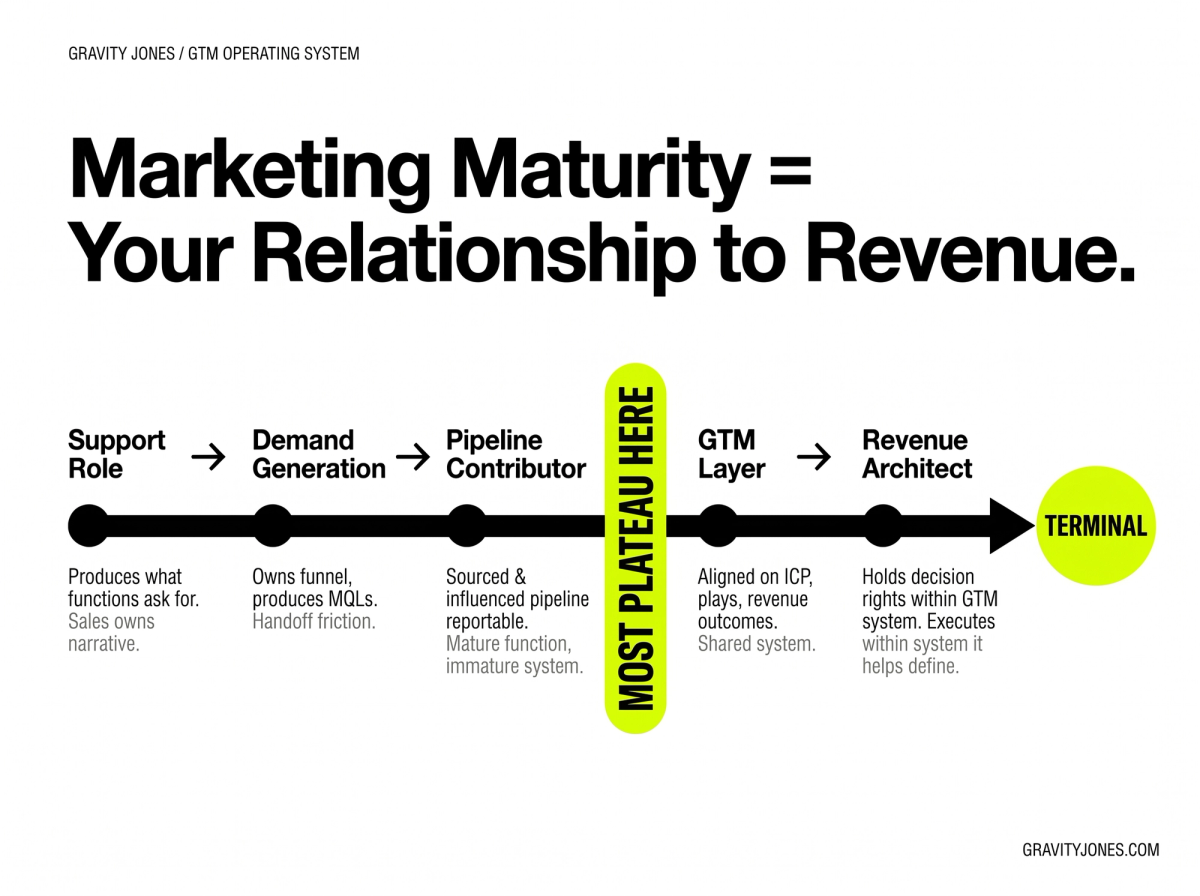
This article walks through a different model. The unit of analysis is marketing's relationship to the revenue system, not the sophistication of the marketing function on its own. Five stages. Four transitions. One plateau most companies never get past.
What the Model Measures
Five stages. Each describes a structural relationship between marketing and how revenue actually gets built at the company.
Stage 1: Support Role. Marketing produces what other functions ask for. Decks, collateral, event logistics, landing pages on request. Sales owns the revenue narrative. Leadership owns strategy. Marketing owns output. There is no marketing number, no funnel, no claim on pipeline. The function is judged on responsiveness and production quality.
This is where most early-stage B2B companies sit, and where many post-founder-led companies sit at much higher revenue than the stage suggests.
Stage 2: Demand Generation. The function owns a funnel. Produces MQLs. Has a stack, a calendar, a budget. Runs campaigns with measurable outputs. The funnel ends at a handoff. Marketing fills the top. Sales closes the bottom. The two functions have different metrics, different incentives, and different definitions of what counts as a real opportunity. Friction at the handoff gets treated as a relationship problem, addressed with alignment meetings.
The function has stopped being a service desk. It is its own vertical with its own kingdom.
Stage 3: Pipeline Contributor. The function is measured on sourced and influenced pipeline. Attribution exists. The CEO can name a number marketing is responsible for. Service level agreements exist on both sides of the handoff. Marketing has functional credibility.
This is where the standard maturity models declare victory. And at the functional level, they are right. The function has matured.
This is also where the ceiling shows up.
Stage 4: GTM Layer. The function operates as a layer inside a horizontal revenue system rather than as a vertical function feeding into it. Shared ICP, owned as a coalition definition rather than as a marketing artifact validated by sales. Joint plays, designed across functions from the same logic. Shared revenue OKRs. Peer-level governance, where the marketing leader is accountable for the revenue number alongside sales and CS rather than feeding into them.
Marketing operates through the GTM. Marketing does not hold decision rights over the GTM itself.
Stage 5: Revenue Architect. The marketing leader holds decision rights at the table where the GTM gets shaped. Segmentation. Pricing. Expansion design. Investment allocation. The decisions remain coalitional. Sales, CS, product, finance, the CEO, and marketing all sit at the table. No single function owns GTM. What changes at this stage is whether marketing has the seat when the system gets set, or receives the system after the fact.
Stage 5 is rare. Stage 4 is uncommon. Most companies plateau at Stage 3 and stay there for years.
What Each Stage Actually Tells You
A few things become legible as soon as you read your function against this scale instead of against a function-only rubric.
The first is that capability is not the same as maturity. A Stage 2 function can be technically excellent at demand generation, attribution, lifecycle programs, and content while still being a Stage 2 function. Capability lives inside the function. Maturity describes how the function relates to the system around it. The two move on different axes.
The second is that "Stage 5" in standard models is mostly tooling. AI-enhanced. Predictive. Integrated tech stack. Those words describe what the function operates with. They say nothing about whether the function operates inside the decisions that shape revenue creation. That distinction is the entire reason CMOs at companies with sophisticated stacks still get replaced on 18-month cycles.
The third is that the transitions between stages are not the same kind of work.
Stage 1 to 2 is a capability build. Hire a marketer with demand generation experience. Stand up a funnel and a measurement baseline. Six to nine months if the mandate is clear.
Stage 2 to 3 is a measurement and political build. Tighten the handoff. Agree on definitions. Build attribution sales trusts. The technical side takes a quarter. The political side — sales accepting that some pipeline they claimed sole credit for was actually marketing-sourced — takes twelve to eighteen months.
Stage 3 to 4 is a restructure. The function rewires from a vertical operating beside sales and CS into a layer operating across them. Shared architecture replaces interlocking silos. The blocker is almost never capability or tooling. It's organizational willingness to dismantle the previous structure. Most companies stall here for years.
Stage 4 to 5 is a decision rights expansion. The marketing leader gains a seat at the GTM table. The transition is mandate-led. Without an explicit CEO and board mandate, Stage 5 is unreachable regardless of how sophisticated the function gets.
The standard models prescribe the same intervention at every transition: add more capability. That works for the first two transitions. It fails at the third because the work is structural, not capability. It fails at the fourth because the work is governance, not capability.
Why Most Companies Plateau at Stage 3
Most B2B marketing functions plateau at Stage 3 and stay there indefinitely. The pattern is so consistent that it warrants naming.
You arrive at Stage 3 having done real work. The funnel runs. The attribution model is in place. The CEO can defend marketing's contribution at the board level. The function has earned its credibility.
Then growth stalls. The board asks marketing why. Marketing asks for more tooling, better attribution, a new program. The board funds it. Nothing moves. Six months later, the same conversation. Twelve months later, a new CMO.
The standard maturity models call this a capability problem. They prescribe lifecycle programs, ABM maturity, customer advocacy motions, more attribution sophistication. You can stack every Stage 4 capability on top of a Stage 3 architecture and still have a Stage 3 organization. The object is wrong. A sophisticated vertical function does not become a horizontal layer by adding more vertical sophistication.
The plateau is structural, not a capability gap. Most companies are willing to fund capability and unwilling to restructure. The CMO gets replaced every 18 months. The function keeps getting more sophisticated. The number keeps getting missed.
This is the diagnostic pattern that breaks the standard model's prescription. Once you see it, the next conversation about "what marketing needs to add" becomes the wrong conversation. The conversation that matters is whether the company is willing to restructure how marketing operates inside it.
Reading Your Own Function
If you are a marketing leader, the model gives you a way to locate yourself that doesn't depend on a vendor framework grading your tooling.
Three questions cut quickly to the placement.
What number is marketing accountable for in your last QBR? Activity metrics map to Stage 1. MQL volume maps to Stage 2. Sourced and influenced pipeline maps to Stage 3. Shared revenue OKRs map to Stage 4. Decision-level authority over how revenue gets built maps to Stage 5.
When the company makes a major GTM decision — pricing, packaging, segmentation, expansion — are you in the room? If decisions get made by the CEO, sales leadership, and product, with marketing receiving the outcome after the fact, you are at Stage 4 at most. If marketing is part of the group that makes those decisions, you are at Stage 5.
In the last 18 months, how many marketing leaders has the company employed? One is steady state. Two suggests transition pressure. Three or more is a structural signal that the system around marketing is producing the same outcome regardless of who runs the function.
The placement matters less than the gap. A Stage 3 function inside an immature GTM has a fundamentally different problem than a Stage 3 function inside a mature GTM. Both look like the same plateau. The work to move out of each is different.
That second axis, the maturity of the GTM system itself, sits outside the scope of this article. It is the other half of the diagnostic. For now, the model gives you the first half cleanly: where your function actually sits, and what kind of work the next transition would require.
What This Model Cannot Tell You
Two things are worth being explicit about.
The model does not measure marketing capability in isolation. A team at Stage 1 can be technically more sophisticated than a team at Stage 3 if the Stage 1 team has unusual depth and the Stage 3 team is operating at a basic competence level. The model reads structural relationship, not skill. A Stage 1 function with brilliant operators is still a Stage 1 function in the system. The capability matters. It just isn't what the model measures.
The model also does not measure GTM system maturity directly. That requires a separate read, performed through frameworks that grade the maturity of the revenue system itself rather than marketing's place inside it. The two readings together produce the diagnosis. Reading only one produces generic prescription.
What the model does well is locate marketing's structural position. That position is the thing most assessments cannot see, because most assessments are looking inside the function rather than at how the function relates to the rest of the company. The model puts the function in context. The context is usually where the actual problem lives.
The Distance Between Where You Are and Where You Need to Be
The standard models give you a maturity score and a list of capabilities to add. The score climbs. The capabilities accumulate. The revenue lift fails to follow.
This model gives you something different. It tells you what kind of work the next transition actually is. Whether it's a build, a restructure, or a mandate. Whether the blocker is capability, structure, or authority. Whether the company you work inside is the kind of company that does that kind of work.
Most marketing leaders working inside complex B2B organizations are running excellent functions inside structurally constrained systems. The function is doing what it can. The system is producing what it can absorb. The gap between the two is where every "marketing isn't producing" conversation actually lives.
The work of maturity is closing that gap. Not adding more to the function. Not replacing the leader. Closing the gap between what marketing is asked to produce and what the system around it is structured to support.
The model maps where you are. The transitions describe what would need to change. The rest is a question of whether the company is willing to do that work — and whether the marketing leader has the seat at the table when the decision gets made.